
RAG-Based AI
Teaching Assistant
Retrieval-Augmented Generation system answering questions from video-based learning content through an end-to-end semantic retrieval pipeline.
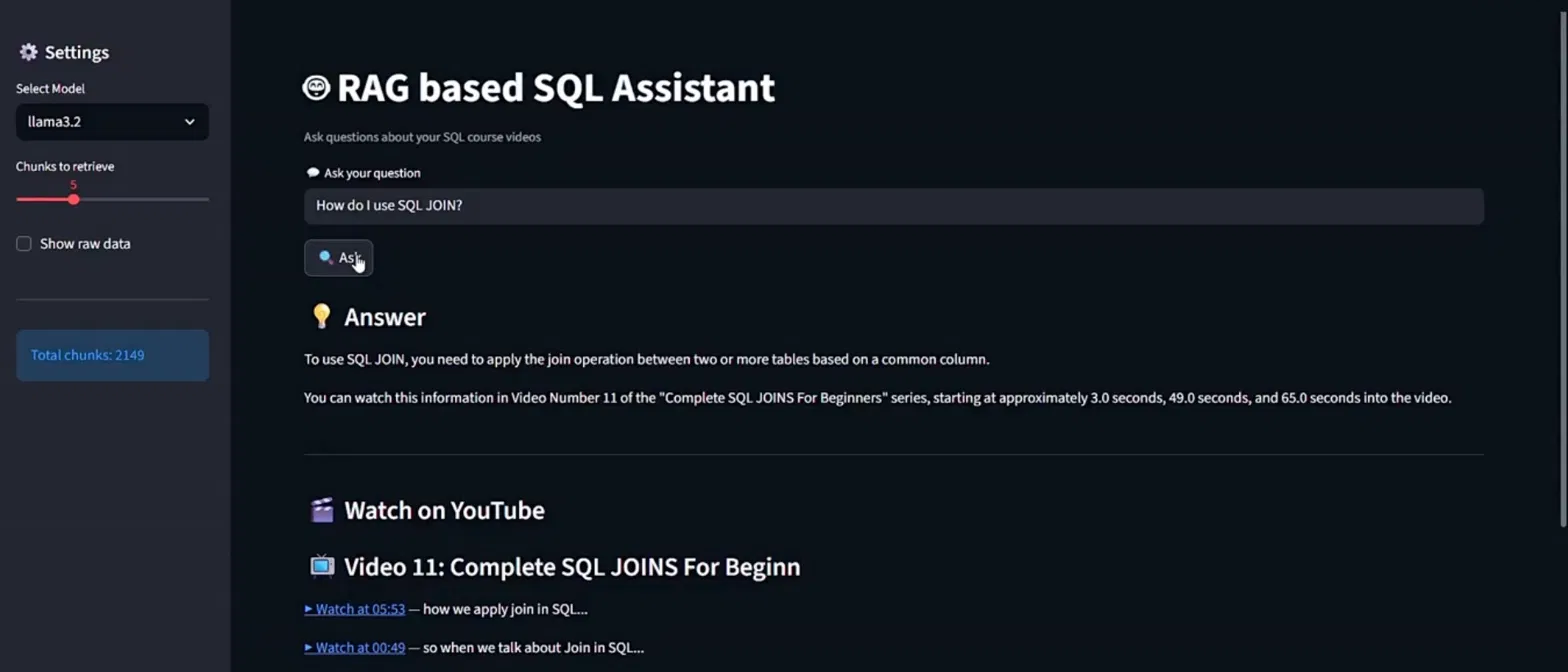
Query & Settings Interface — Model selection, chunk retrieval configuration, and query interface demoed on SQL coursework as "RAG based SQL Assistant."
- 01Video-to-text transcription via FFmpeg audio extraction and speech-to-text processing
- 02Embedding generation and vector storage for timestamped lecture content
- 03Semantic retrieval to answer questions with reduced hallucinations through context-aware grounding
System Intent & Pedagogical Impact
The RAG-Based AI Teaching Assistant is a Retrieval-Augmented Generation system built to answer questions from video-based learning content. It transforms recorded lecture videos into a queryable knowledge base, enabling students to ask precise conceptual questions and receive grounded, context-aware responses that reduce hallucinations through semantic retrieval rather than generative guessing.
Signal Ingestion & Embedding Pipeline
The pipeline begins with FFmpeg extracting audio from lecture video files, which is then passed through a speech-to-text transcription stage to produce timestamped text. Those transcripts are converted into vector embeddings stored in a vector index. When a student submits a query, the system searches this store to surface the most contextually relevant lecture segments, grounding its response in the actual source material.
Conversational Fabric & Interaction
Built with Python and Streamlit, the application provides a conversational interface where students can ask questions about lecture content and receive answers grounded in retrieved transcript segments. By anchoring responses to semantically retrieved context, the system improves response relevance and reduces hallucinations compared to ungrounded generative approaches.